The last float rolled past Old Kōloa Church on Saturday, July 25, and by Monday morning the Poʻipū Road corridor was quiet again. That transition is the interesting part of the south-shore calendar, and it is almost never written about. The parade gets the coverage. The two weeks after it, when the same market, the same coastal trail, and the same reservation books hand themselves back to people who live here, get none.
The claim of this post is small and specific. Poʻipū's fall does not begin in September. It begins the Wednesday after the Kōloa Plantation Days closing weekend, when the infrastructure that has been shared with ten days of visitors returns to a resident's pace right as the weather starts to reward it. If you have been on the south shore long enough to have a Wednesday habit, you already feel this. The post is about what to do with it.
What the Parade Actually Redistributes
For the 41st Plantation Days, the Kauaʻi Police Department closed Poʻipū Road from Kiahuna Golf Course to Kōloa Road, Kōloa Road from Ala Kalanikaumaka to Weliweli, and Maluhia Road down to Ala Kinoiki, with the Maluhia closure held by a private security company until 8 p.m. Ala Kalanikaumaka and Ala Kinoiki carried the in-and-out traffic all afternoon. If you were leaving Poʻipū for Līhuʻe between 2 and 5 p.m. on July 25, you already know which road you used.
What matters for August is what those closures signaled. Every year, the Grand Parade compresses ten days of festival programming into one Saturday afternoon and then unwinds it in a single evening. By the following Wednesday, three things reset at once:
- The Culinary Market at The Shops at Kukuiʻula returns to its normal Wednesday shape, not the Plantation Days special edition.
- The coastal trail out of Shipwreck Beach loses its parade-week visitor peak.
- Reservation books at Merriman's, RumFire, and Tidepools loosen for weeknights.
None of these are events. They are the absence of events, which is the harder thing to notice from a listing page.
Wednesday, 3:30, and Why It Reads Different in August
The Culinary Market runs every Wednesday from 3:30 to 6 p.m. at 2829 Ala Kalanikaumaka, in partnership with the Kauai County Farm Bureau, and features more than 25 local farmers and vendors with a 5 p.m. chef demonstration. That is the year-round shape. It is worth stating plainly because the market that most visitors describe online is the July version, which is a different animal.
The July 22 edition this year, timed inside Plantation Days, brought Kauaʻi Diner Kōloa chefs Ace DeLeon, Aaron Balicoco, and JD Suero to Palm Court to demo Pork Tinono, a Filipino dish, in front of a market that also held the Kauai Historical Society's book table. That is a celebratory Wednesday. The August Wednesdays are the useful ones. Same vendors, same 5 p.m. demo, less line at the coconut stand, easier parking on the Ala Kalanikaumaka side, and enough breathing room to actually talk to the growers about what will be worth buying in September. Bring cash. Bring your own bags. Come at 4 rather than 5 if you want to shop before the demo crowd forms.
Where Dinner Lands After the Crowds Thin
The south-shore dining rooms are not shy about their categories. What changes in August and September is availability, not menu. Merriman's Poʻipū was recognized in the 2026 Honolulu Magazine Hale ʻAina awards as Gold for Best Farm to Table and Bronze for Best Seafood, and roughly 90 percent of its ingredients are sustainably grown or caught. RumFire Poʻipū Beach at the Sheraton runs Thursday through Sunday from 5 to 9 p.m. with a late happy hour from 9 to 10 that a lot of residents forget about. Table at Poʻipū takes reservations by phone at 808-742-7037, which is a small signal that it is still built for regulars rather than for portal-driven booking.
Here is a rough shape of what fits which kind of evening, once the parade weekend clears:
| The evening you're planning | Where it lands |
|---|---|
| Sunset with visiting family, oceanfront | RumFire Poʻipū Beach, Sheraton |
| Long, quiet farm-to-table dinner | Merriman's Poʻipū |
| Special occasion, lagoon and thatched setting | Tidepools, Grand Hyatt |
| Sushi and koa-wood bar after golf | Stevenson's Library, Grand Hyatt |
| Casual, live hula, family with kids | Keoki's Paradise |
| Pacific Rim, small-room feel | Table at Poʻipū |
| Brunch in Kōloa Village, walkable | Break + Feast, from the Kiawe Roots team |
| Late plate lunch, no fuss | Kauaʻi Diner Kōloa |
| Italian, wood-fired, mid-week | Isola Cucina Poʻipū |
| Post-beach hot dog at the park | Puka Dog, next to Brennecke's |
Break + Feast opened in Kōloa Village in 2024 and reads like a locals' brunch by design, with customizable loco moco, green chile skillets, and lilikoi pancakes; it belongs in this list because it fills the one gap the resort rooms leave, which is a proper morning after a Saturday at the beach.
The Coastline Comes Back to Its Owners
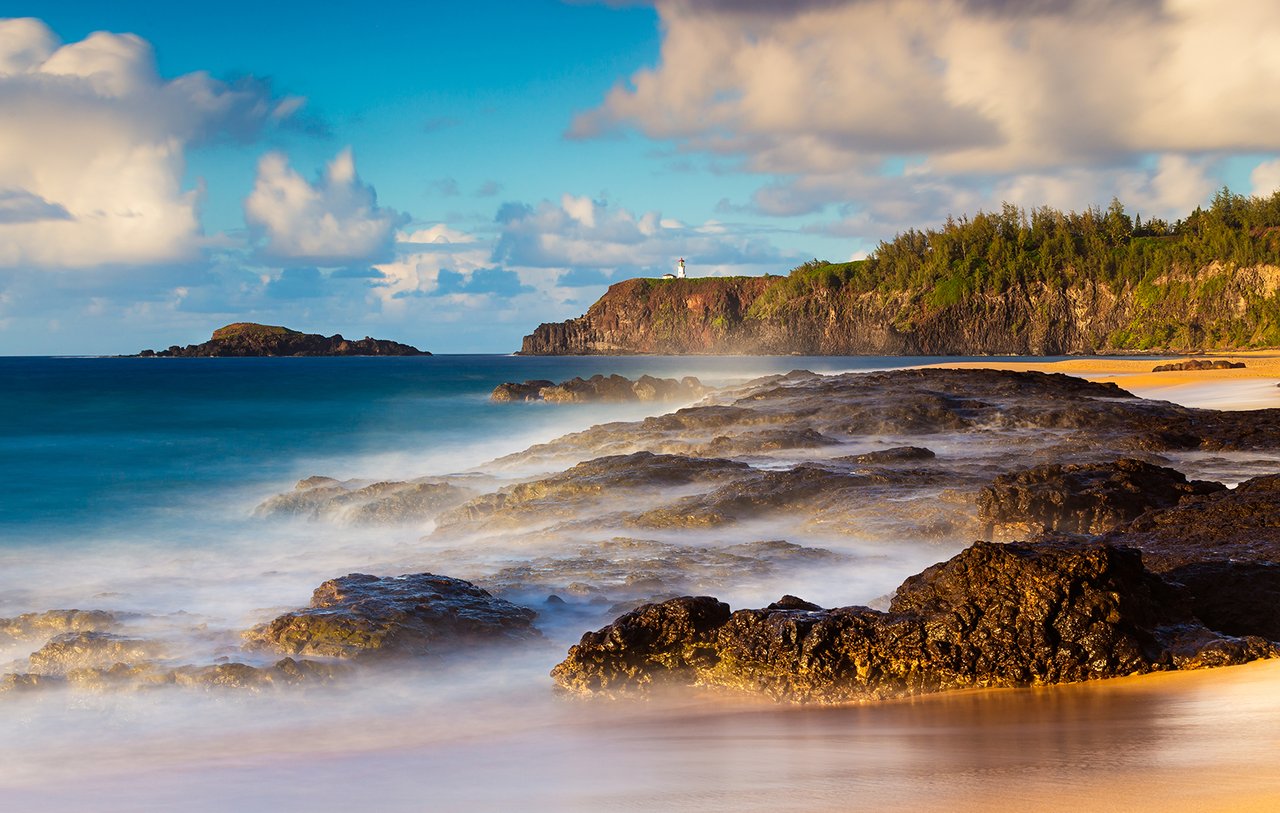
The Mahaʻulepu Heritage Trail is a two-mile coastal walk from Shipwreck Beach along Keoneloa Bay to Mahaulepu Beach near Kawailoa Bay, past the lithified cliffs at Makauwehi Cave and the Grand Hyatt fairway edge. In late July, it is a shared corridor. By mid-August, it is early-morning territory again for the people who walk it three or four times a week. The trail does not change. The population using it does.
The same is true of Poʻipū Beach Park itself. It runs to about six acres, is lifeguarded, opens dawn to dusk, and is one of the more consistent places on Kauaʻi to see Hawaiian monk seals hauled out on sand. In fall, the beach still fills by mid-morning, but the pre-9 a.m. window loosens noticeably, and the eastern end past Nukumoi toward Brennecke's regains the smaller, quieter footprint it has the rest of the year. The Sunday Family Fun Run that closes Plantation Days finishes here on July 26, which is a useful mental bookmark: the run is the last time the park operates as a festival venue until December.
Kāneiolouma, Which Rewards a Second Visit
Kāhua O Kāneiolouma sits in the heart of Poʻipū, across from the park, as a restored ancient Hawaiian village with heiau, house sites, fishponds, and cultivation terraces stewarded by Hui Mālama o Kāneiolouma. During Plantation Days, the site hosted a guided talk story on July 20 at 9 a.m. that walked through the group's ongoing restoration work. The talk is annual. The site is open the other 51 weeks. Most Poʻipū residents drive past it every day and have never actually walked through it. August, when the parking pressure at the park across the street is lower, is a defensible time to fix that.
The parade is a bookmark, not the plot. The plot is what the south shore does with the fifty weeks around it.
The Read from Kōloa Road
None of this is a case for Poʻipū as a place to move to. That is a different post for a different reader. This is a case for how a resident's August, September, and October actually pattern in 2026, once the Kōloa Road closures come down and the town returns to itself. The Wednesday market is the anchor. The coastal trail is the release valve. Merriman's, RumFire, Tidepools, Keoki's, Break + Feast, Table at Poʻipū, Isola Cucina, and Kauaʻi Diner Kōloa are the rotation, and the reservation books thin out at exactly the moment the trade winds start to reward evenings on a lanai.
If you have lived here long enough, the fall reset is not news. What is worth naming is that the reset is the reason the south shore holds long-term residents in the first place. Ten days of Plantation Days give you the history. The fifty weeks around it give you the life.
If you are thinking about the ownership side of that life, or about the design and permitting side of a home that will hold up to it, the team at Bruce Whale works quietly across Poʻipū, Kōloa, and the wider south shore. When you're ready, we're glad to schedule a Kauaʻi Concierge Consultation.