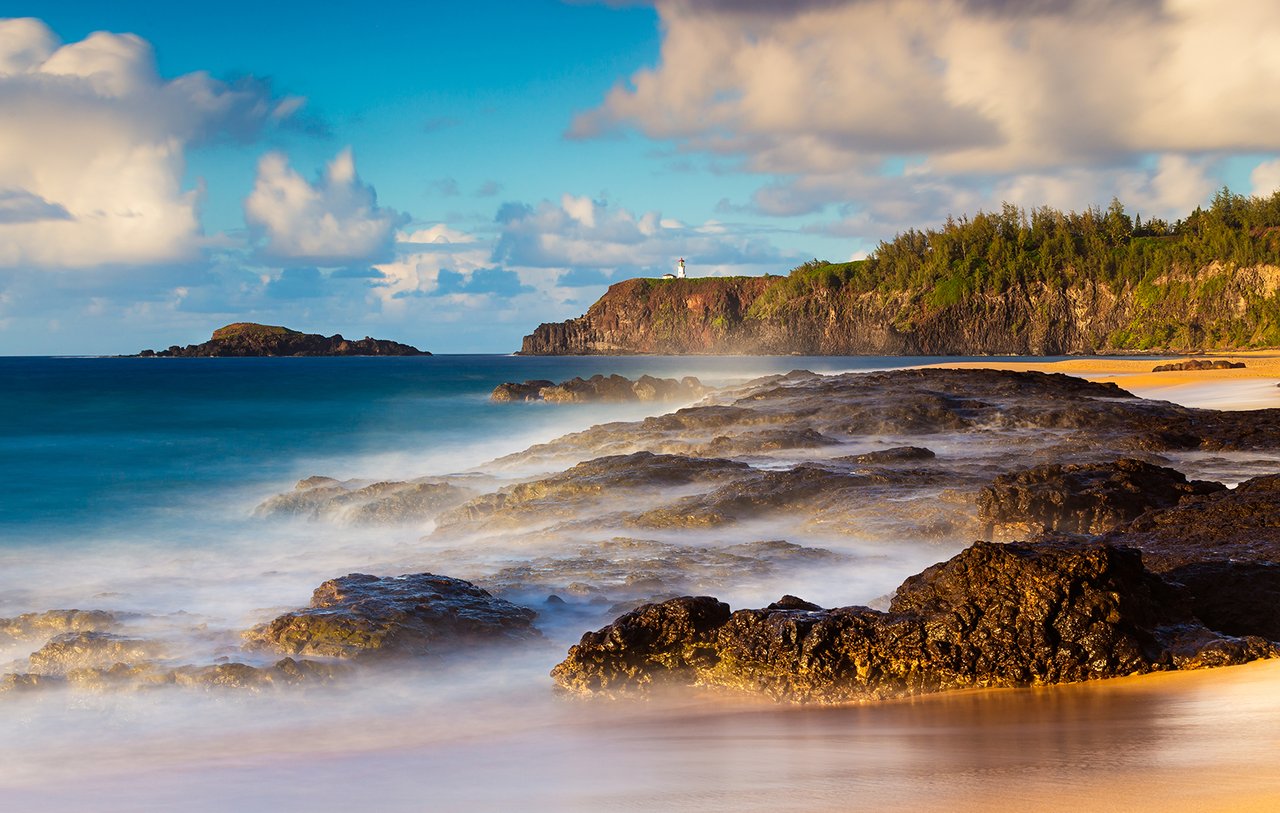
Ask someone who has never lived here what Kilauea is, and they will describe a lighthouse on a cliff, red-footed boobies wheeling over a 180-foot bluff, maybe a nēnē crossing the road. Ask someone who has lived here for a year what they actually do on a Wednesday night, and the lighthouse rarely comes up at all.
That gap is the whole story. Kīlauea Point National Wildlife Refuge is the image the world has of this town, but it is also the one fixture on Kilauea's calendar that a resident cannot simply show up to. Everything else that fills a week here, the fire shows, the Saturday market, the farm tour, the bakery run, happens on a loop that never asks permission from anyone.
The corridor that does the work
Two properties carry most of Kilauea's recurring life, and they happen to sit on the same trail system. Anaina Hou Community Park, on Kūhiō Highway, backs onto the Wai Koa Loop Trail. Common Ground, the regenerative farm a short drive away on Kuawa Road, offers its own optional walk from the farm tour out to the same Wai Koa Loop Trail and the 1880 Stone Dam, a stacked-stone relic from Kilauea's sugar plantation era that still channels water on the property today. Two of the town's busiest weekly draws, a 30-acre community park and a 60-acre former guava plantation turned food forest, are stitched together by the same footpath.
That matters more than it sounds like it should. On a stretch of the North Shore where most amenities string out along the highway and require a drive between them, Kilauea's recurring anchors cluster close enough that a resident can move between a farmers market and a farm tour without merging back onto Kūhiō Highway at all.
What actually recurs
Anaina Hou runs on a schedule, not a whim. The Ahi Lele Fire Show, a mix of hula and fire dance staged at the Porter Pavilion, happens on Monday and Wednesday nights. Friday belongs to Kanikapila, a family gathering built around Hawaiian music and dance with dinner included. Saturday mornings are the Farmers' Market, with Silvercloud Eatery on site for brick-oven pizza afterward. None of this is seasonal programming. It repeats, week after week, which is the difference between a pop-up and an actual rhythm.
Here is how a typical week breaks down across the two properties:
| Day | Anchor | Location |
|---|---|---|
| Monday | Ahi Lele Fire Show | Porter Pavilion, Anaina Hou |
| Wednesday | Ahi Lele Fire Show (repeat) | Porter Pavilion, Anaina Hou |
| Friday | Kanikapila, dinner included | Porter Pavilion, Anaina Hou |
| Saturday | Farmers' Market | Anaina Hou grounds |
| Weeknights | Farm & Food Experience, walking tour and family-style meal | Common Ground, Kuawa Road |
Common Ground's own schedule has shifted the specific evenings it runs over time, but the pattern holds: a walking tour through the food forest, a fruit tasting, and a family-style meal built entirely from island-grown ingredients, most weeknights, not just weekends. Anaina Hou is also mid-construction on a $24 million Kauai Resilience Center, meant to double as a vocational training space and disaster shelter, which tells you this isn't a park coasting on a single mini-golf course and a playground. It is building for the next few decades of use.
What sits inside Kong Lung
A few minutes from Anaina Hou, at 2484 Keneke Street, sits the other half of Kilauea's daily texture: the Historic Kong Lung Market Center, built inside the old Kilauea Sugar Plantation company store and listed on the Hawaii Registry of Historic Places. This is where the town's daily errands happen, not its weekly events.
Inside and around that one building:
- Kong Lung Trading, the boutique the center is named for, selling gifts, home decor, and apparel in the original plantation-era space
- Kilauea Bakery, for the morning coffee-and-pastry run
- A soap factory and a handful of smaller shops tucked into the same courtyard
- The Bistro, a seafood-forward dinner spot open weekdays from noon
- Palate Wine Bar and Restaurant, a few doors down
- Kilauea Fish Market and Kauai Boba and Barbecue for quicker meals
None of these are new. What is worth noticing is how much daily function is packed into one historic footprint, so that a resident's actual errands, coffee, dinner, a gift for someone visiting, rarely require driving toward Princeville or Hanalei.
The one appointment on the calendar
Then there is the refuge itself, and this is where Kilauea's rhythm runs into a rule it did not write. Kīlauea Point National Wildlife Refuge is open to the public only Wednesday through Saturday, 10 a.m. to 4 p.m., with visitors required to arrive by 3:30. Every adult 16 and older needs a reservation made through Recreation.gov before showing up. Walking in is not an option: the driveway is too steep and narrow, and the refuge asks visitors to arrive by vehicle or bike.
That system tightens further starting in early November, when migratory mōlī, the Laysan albatross, return to Kīlauea Point to begin their courtship season. The birds are known for an elaborate ritual: synchronized head bounces, neck stretching, and calls that sound closer to a horn than a bird. It is one of the more reliable natural spectacles on this coast, and it draws enough attention that the same reservation window residents use in July gets noticeably harder to book once the mōlī arrive.
So the town's most recognizable landmark is also its least flexible one. Everything else on Kilauea's calendar, the fire show, the market, the farm tour, the bakery counter, runs on local time. The refuge runs on federal time, and every November that difference becomes obvious to anyone who tried to walk up on a whim.
The takeaway
The postcard version of Kilauea puts the lighthouse in the center of the frame. The lived version puts it at the edge, as the one place on the map that still requires planning ahead while the rest of the town runs on repeat. That is not a criticism of the refuge. Protecting a 168-acre seabird colony behind a two-mile predator fence requires exactly the kind of structure a farmers market does not. But it does mean the real texture of a Kilauea week is built somewhere else entirely, on the loop between Anaina Hou and Common Ground, and inside one converted plantation store on Keneke Street.
If you already call Kilauea home, none of this is news. It is just useful to see it laid out: the town has quietly built a full week of recurring, resident-facing life that has nothing to do with the one thing outsiders assume defines it.
For anyone thinking further ahead, whether that means finding a property closer to this loop or understanding how a North Shore lot fits into the town's rhythm, the team at Bruce Whale knows this stretch of coastline block by block. Reach out to schedule a Kauai Concierge Consultation when you are ready to talk specifics.